
By OKE, Oluyemi Joseph
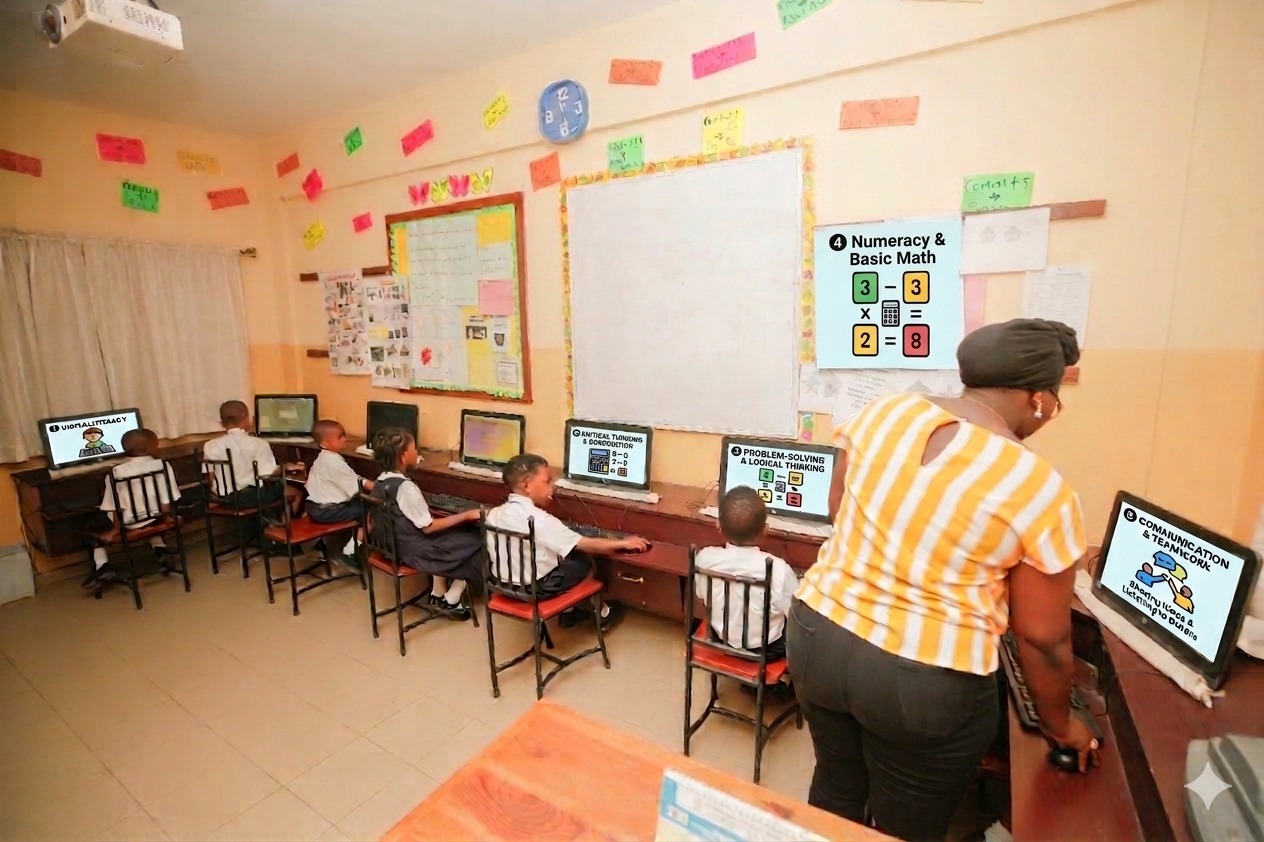
Primary school is more than a place where children learn to read, write, and calculate. It is the training ground for life. The skills cultivated during these formative years determine not only academic success but also how a child navigates relationships, challenges, and opportunities in the future. While subject knowledge is important, there are foundational skills that serve as the bedrock for all other learning. Here are the top five skills every primary school pupil must develop to thrive in school and beyond.
1. Foundational Literacy and Numeracy: The Gateway to All Learning
Before a child can learn anything else, they must possess the fundamental tools to access knowledge. Foundational literacy and numeracy are non-negotiable. They are the keys that unlock every other subject and every future opportunity.
- Literacy: This goes beyond simply recognizing letters. A primary school pupil must develop the ability to read with comprehension and express themselves clearly in writing and speech. Without strong reading skills by the end of primary school, a child is at risk of falling behind in every other subject—from science to social studies. Literacy is the foundation upon which all other learning is built.
- Numeracy: Foundational numeracy means more than memorizing multiplication tables. It involves understanding number sense, patterns, measurement, and basic problem-solving. A child with strong numeracy can think logically, make sense of data, and navigate everyday situations like managing time, handling money, and making reasoned decisions.
Why it matters: A child who leaves primary school without these fundamentals faces a lifetime of disadvantage, often referred to as “learning poverty.” These skills are the absolute baseline for future education, employability, and informed citizenship.
2. Critical Thinking and Problem-Solving: The Ability to Navigate Complexity
In a world overflowing with information, the ability to think critically is more valuable than the ability to memorize facts. Primary school pupils must learn to move beyond simply accepting information to questioning, analyzing, and applying it.
- Curiosity and Questioning: Pupils should be encouraged to ask “why,” “how,” and “what if.” They need to learn that not every problem has a single answer and that exploring multiple solutions is a strength.
- Logical Reasoning: This involves identifying patterns, making connections between ideas, and understanding cause and effect. Simple puzzles, science experiments, and open-ended questions in class help build this muscle.
- Problem-Solving Under Pressure: Children must learn to approach challenges methodically—identifying the problem, brainstorming solutions, trying an approach, and learning from failure. Resilience in problem-solving is a skill that will serve them in academics, relationships, and future careers.
Why it matters: Automation and artificial intelligence are changing the nature of work. The jobs of the future will demand creativity, analysis, and complex problem-solving—skills that cannot be replicated by machines. These abilities must be nurtured from primary school.
3. Social-Emotional Competence: Mastering Self and Relationships
Academic success is built upon emotional stability and social skills. A child who cannot manage their emotions or work with others will struggle no matter how academically gifted they are. Social-emotional competence encompasses several critical sub-skills:
- Self-Awareness and Self-Regulation: Pupils must learn to identify their own emotions—frustration, excitement, disappointment—and develop strategies to manage them constructively. This includes impulse control, the ability to delay gratification, and the resilience to cope with setbacks.
- Empathy and Perspective-Taking: Understanding that others have feelings, needs, and viewpoints different from their own is essential for building healthy relationships. Empathy reduces bullying, fosters inclusion, and builds community.
- Collaboration and Teamwork: Primary school is where children learn to share, take turns, listen to others, contribute to a group effort, and resolve conflicts peacefully. These are the foundational skills for every healthy family, workplace, and community.
Why it matters: Emotional intelligence is consistently ranked by employers as one of the most sought-after qualities. More importantly, it is the foundation of mental health, healthy relationships, and a fulfilling life.
4. Effective Communication: The Art of Expressing and Connecting
Being able to read and write is not enough. A pupil must learn to communicate effectively—to express thoughts clearly, listen actively, and adapt their communication to different audiences and contexts.
- Verbal Communication: This includes speaking clearly, using appropriate language, articulating thoughts in class discussions, and having the confidence to ask questions or seek help when needed.
- Active Listening: True communication is as much about listening as it is about speaking. Pupils must learn to listen attentively to teachers and peers, process what is being said, and respond thoughtfully rather than simply waiting for their turn to talk.
- Expressive and Persuasive Skills: Whether writing an essay, giving a short presentation, or participating in a debate, children need practice in organizing their thoughts and presenting them persuasively and respectfully.
Why it matters: Communication is the bridge between thought and action. A child who can communicate effectively can advocate for themselves, build strong relationships, share their ideas with the world, and become a leader in their community.
5. Adaptability and a Growth Mindset: The Capacity to Embrace Change
The world is changing faster than ever before. The specific facts a child memorizes today may be obsolete tomorrow. What will never become obsolete is the ability to learn, unlearn, and relearn. This is the essence of adaptability and a growth mindset.
- Growth Mindset: Pupils with a growth mindset believe that their abilities can be developed through effort, good strategies, and learning from mistakes. They do not see failure as a reflection of their worth but as a step in the learning process. They embrace challenges rather than avoiding them.
- Flexibility: Children must learn to adapt to new situations, new rules, new classmates, and new ways of doing things. Rigidity leads to frustration; flexibility leads to resilience.
- Curiosity for Continuous Learning: The ultimate skill is the desire to keep learning. Primary education should leave children not exhausted by learning but hungry for more—eager to explore new topics, ask new questions, and pursue their interests with enthusiasm.
Why it matters: We are preparing children for a future we cannot predict. The most critical skill we can give them is the ability to navigate uncertainty, learn continuously throughout life, and grow from every experience—whether success or setback.
Conclusion: A Holistic Vision for Primary Education
These five skills—foundational literacy and numeracy, critical thinking, social-emotional competence, effective communication, and adaptability with a growth mindset—are not separate subjects to be taught in isolation. They are interwoven threads that together form the fabric of a capable, resilient, and thriving individual.
When a primary school pupil masters these skills, they are not merely prepared for the next class; they are equipped for life. They become children who can read to learn, think to solve, feel to connect, speak to inspire, and adapt to overcome. For parents, educators, and policymakers, the goal must be to ensure that every child, regardless of background, leaves primary school possessing these five essential tools. In doing so, we are not just educating children; we are building a foundation for a generation that can truly thrive.
OKE, OLUYEMI
HEAD OF SCHOOL, ERINDALE SCHOOLS