
By OKE, Oluyemi Joseph
The purpose of education extends far beyond the transmission of academic knowledge. In a rapidly changing world, the goal is to raise well-rounded, resilient, and capable human beings. This is the essence of holistic development—an approach that nurtures a child’s cognitive, emotional, social, physical, and moral dimensions in an integrated way. For schools, this means shifting from a model that merely imparts information to one that cultivates the whole child. Here is how schools can effectively champion this mission.
1. Redesigning the Curriculum: Integration Over Isolation
A holistic curriculum moves beyond rote memorization and subject silos. Instead, it integrates learning, showing children how knowledge connects to life.
- Project-Based Learning: Schools can adopt project-based learning where a single theme—such as “Our Local Community”—weaves together literacy (writing about community helpers), numeracy (mapping and measuring distances), civic education (understanding local governance), and art (creating a mural). This approach mirrors real-world complexity and fosters critical thinking.
- Life Skills Integration: Core competencies like financial literacy, problem-solving, and digital citizenship should be embedded across subjects, not taught as standalone, optional topics.
- Culturally Relevant Content: A holistic curriculum reflects the child’s own environment, using local stories, languages, and contexts to make learning meaningful and affirming.
2. Empowering Educators as Holistic Mentors
Teachers are the architects of the learning environment. For holistic development to occur, teachers must be trained to see themselves as mentors, not just instructors.
- Social-Emotional Learning (SEL) Competency: Teacher training must include strategies for fostering SEL. This means equipping educators to facilitate classroom discussions on emotions, model empathy, and integrate practices like mindfulness or conflict resolution circles.
- Differentiated Instruction: Recognizing that each child develops at their own pace, teachers need the skills and resources to cater to diverse learning styles and needs, including identifying and supporting children with learning challenges or exceptional gifts.
- Strong Teacher-Student Relationships: Schools must foster a culture where teachers are accessible, supportive, and know their students as individuals. A strong, trusting relationship with a caring adult is one of the most critical factors for a child’s overall well-being and academic success.
3. Creating a Safe and Nurturing Physical Environment
A child’s environment profoundly impacts their ability to learn and grow. Schools must be more than just buildings; they must be sanctuaries.
- Safety and Belonging: The primary responsibility is to ensure physical and emotional safety. This means having clear anti-bullying policies, a zero-tolerance approach to corporal punishment (still a reality in many contexts), and actively cultivating a culture of inclusion where every child feels they belong, regardless of background or ability.
- Spaces for Movement and Play: Holistic development requires space. Schools need to provide and prioritize safe playgrounds, sports fields, and dedicated time for unstructured free play. Physical activity is crucial not only for physical health but also for cognitive function, emotional regulation, and social skill development.
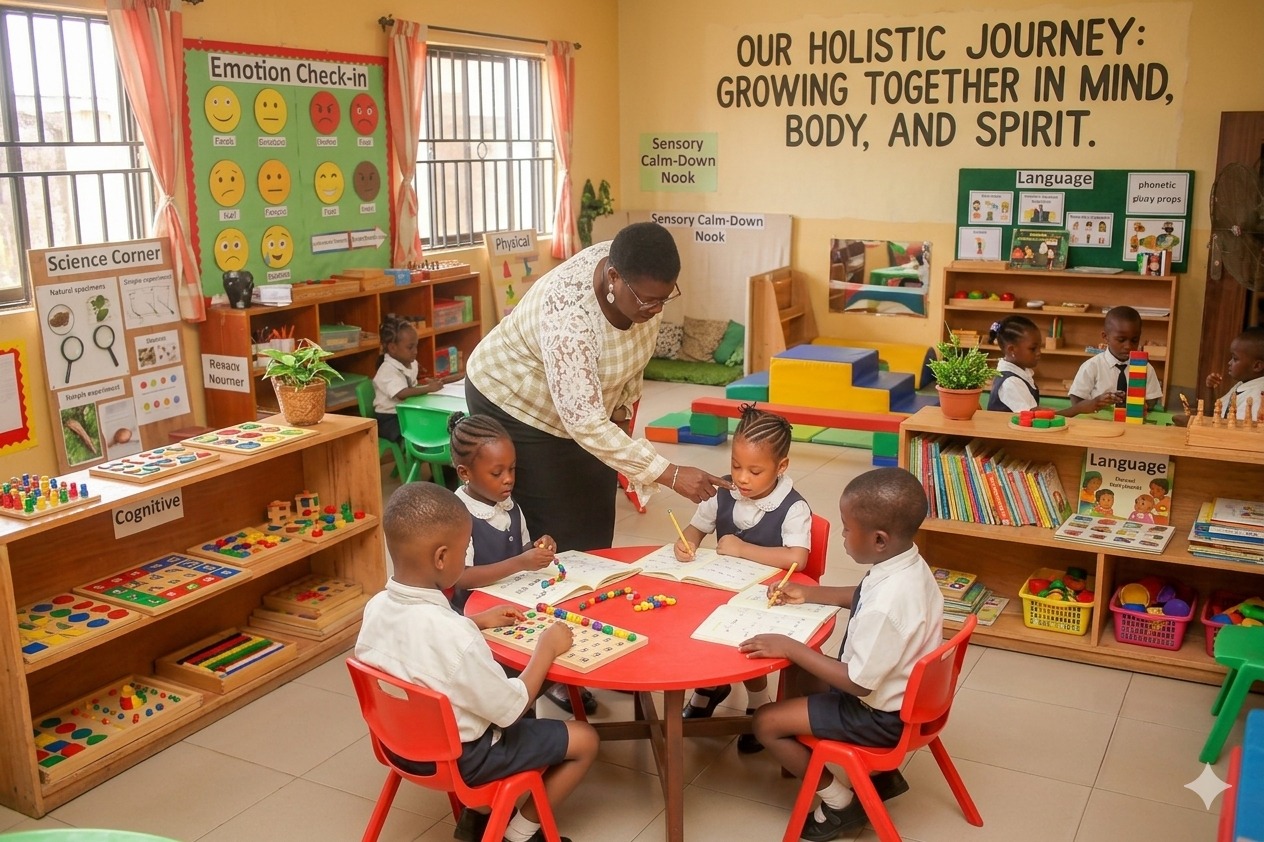
- Aesthetic and Inspiring Spaces: Classrooms should be stimulating, displaying student work, filled with diverse books, and organized to facilitate both collaborative group work and quiet individual focus.
4. Making Social-Emotional Learning (SEL) Explicit
Holistic development requires that social and emotional skills be taught with the same intentionality as math or reading. Schools can embed SEL by:
- Dedicated SEL Time: Having a specific time for lessons on self-awareness, self-management, responsible decision-making, relationship skills, and social awareness.
- Integrating SEL into Academics: Using literature to explore moral dilemmas, using history to discuss empathy and perspective-taking, and using group science projects to practice collaboration.
- Restorative Practices: Instead of purely punitive discipline, schools can adopt restorative justice practices that focus on repairing harm, understanding the impact of one’s actions, and reintegrating students into the community. This teaches accountability and conflict resolution rather than simply punishing behavior.
5. Fostering Student Agency and Voice
Holistic development aims to raise active, engaged citizens. Schools can cultivate this by giving students a genuine voice in their own education.
- Student-Led Initiatives: Establishing student councils, clubs (debate, coding, arts, environmental), and peer mentoring programs allows students to explore interests, develop leadership skills, and take ownership of their school community.
- Choice and Autonomy: Providing students with choices in their learning—such as selecting topics for research, choosing how to demonstrate their understanding (e.g., a presentation, a model, a short film), or having a say in classroom rules—fosters intrinsic motivation and a sense of agency.
- Growth Mindset Culture: Schools should praise effort, perseverance, and resilience rather than just innate ability. Creating an environment where mistakes are viewed as learning opportunities helps children develop resilience and a healthy relationship with challenge.
6. Engaging Families and the Community
A school cannot develop a child in isolation. Holistic development requires a strong partnership between the school, the family, and the wider community.
- Open Communication: Schools should establish consistent, two-way communication with parents, not just to report problems but to celebrate successes and share insights into the child’s development.
- Parent Education and Involvement: Offering workshops for parents on topics like child development, digital safety, and positive discipline can align the home and school environment. Creating volunteer opportunities for parents and community members enriches the school experience.
- Community as Classroom: Partnering with local businesses, health clinics, arts organizations, and traditional leaders can provide real-world learning opportunities and a network of support that reinforces the values and skills taught at school.
Conclusion
Supporting holistic development is not an add-on or an extracurricular luxury; it is the core mission of a truly effective school. It requires a deliberate shift in mindset—from seeing children as vessels to be filled with facts to seeing them as complex, capable individuals to be nurtured. By redesigning the curriculum, empowering teachers, creating a safe environment, embedding SEL, fostering student voice, and partnering with families, schools can fulfill their highest purpose: to equip every child not just for an exam, but for a life of purpose, contribution, and well-being. In doing so, they lay the foundation not only for individual success but for a more compassionate, resilient, and thriving society.
OKE, OLUYEMI JOSEPH
Head of School, Erindale Schools